
Let them leave, and learn why: what AI can hear on a cancellation call
Three in four Australians have had a bad experience cancelling a subscription. The cancellation call is where you learn most and handle worst. Here's how to do it better.
A customer who rings to cancel is about to tell you something no survey will: why they're leaving. Most businesses spend that call trying to talk them out of it, and learn almost nothing.
This post looks at what Australians say about cancelling, what the new subscription rules will require, and whether people really tell a machine more than a person.
What Australians say about cancelling
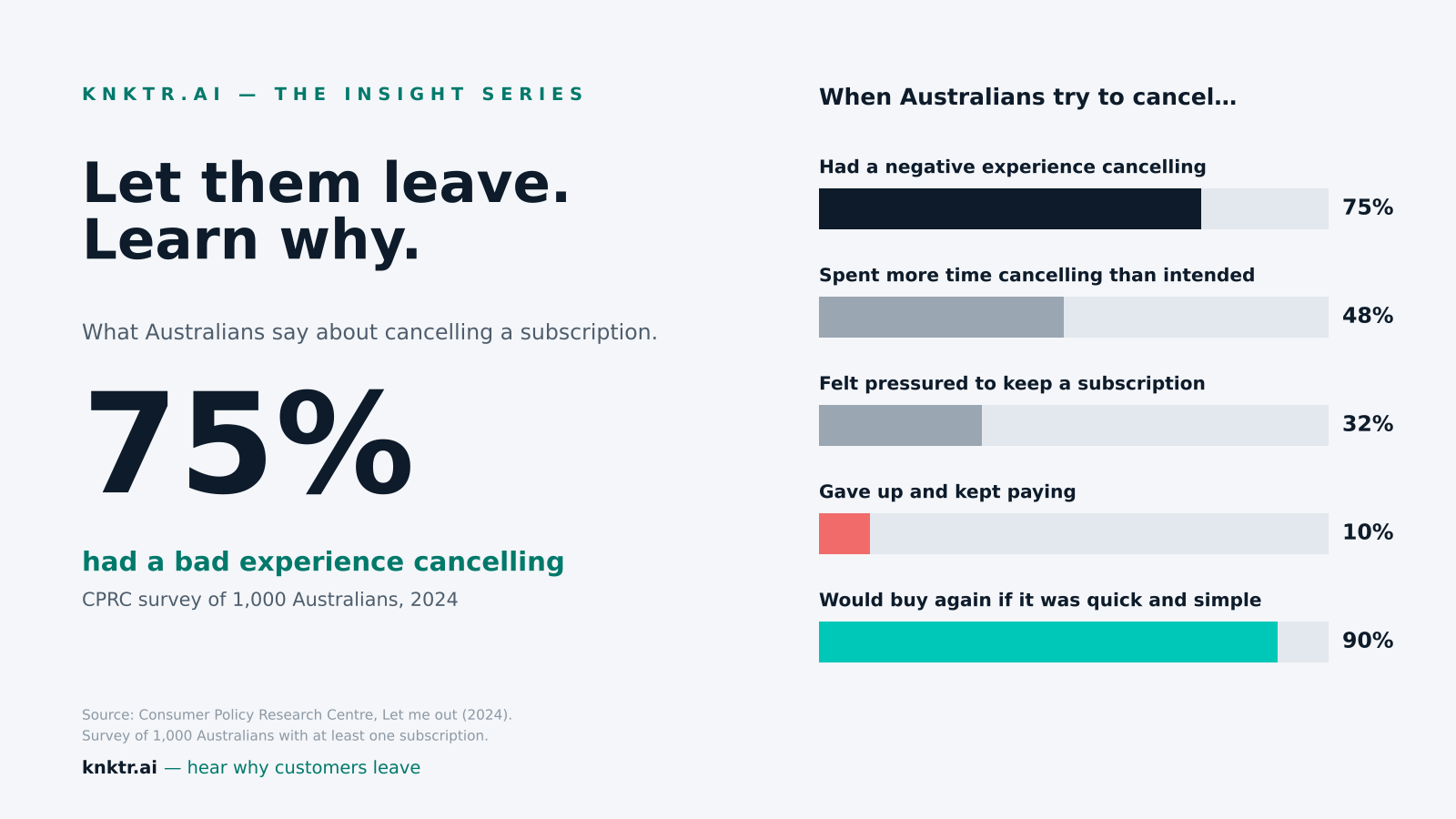
In 2024 the Consumer Policy Research Centre surveyed 1,000 Australians with at least one subscription. The results aren't flattering to anyone who runs a cancellation line:
75% had a negative experience when they tried to cancel.
48% spent more time cancelling than they meant to.
32% felt pressured into keeping a subscription.
10% gave up trying and kept paying for something they no longer wanted.
The same survey found 90% would likely buy from the business again if cancelling had been quick and simple.
The regulator is watching too. In December 2025 the ACCC took HelloFresh and Youfoodz to the Federal Court over alleged subscription traps. It alleges HelloFresh customers could only cancel their first delivery by speaking with a customer service representative, and that more than 100,000 customers across the two businesses were charged despite cancelling in time.
The rules are changing in 2027
Parliament passed new unfair trading practices laws in July 2026. The subscription rules start on 1 July 2027. As law firms summarise them:
Cancelling must be easy to find and straightforward.
The steps must be limited to what's reasonably necessary to end the contract and protect the customer.
If people can sign up online, they must be able to cancel online.
Cancellation terms and notice periods must be disclosed before someone signs up.
The explanatory material suggests that making people give extensive feedback before they can leave is unlikely to be reasonable. A cancellation call that's really a retention gauntlet is the wrong thing to build in 2027.
Why the reason you hear isn't always the reason
Ask people why they're cancelling and most say price or that they don't use it. In a 2024 US survey of 1,091 people who had cancelled a subscription, 63% named cost and 58% named not using it enough.
Those answers are true often enough. They're also the easiest thing to say to a stranger who's about to make you an offer. "Your service let me down" or "I've found something better" invites a debate; "it's too expensive" ends one. Only about half of the same respondents were asked for feedback at all.
Do people tell a machine more?
Sometimes, and the research is worth reading carefully.
They can disclose more. In a 2014 USC study, 239 adults were interviewed by an on-screen virtual human. Those told it was fully automated were more honest about embarrassing symptoms than those told a person was operating it. They worried less about being judged.
They can also lie more. A 2026 study from Sun Yat-sen University found people were more willing to exaggerate or make false claims to an AI agent than to a person, for the same reason: less fear of being judged.
AI is a poor closer once people know. In a 2019 field experiment with about 6,000 customers, sales fell by nearly 80% when customers were told before buying that they were talking to a bot.
None of these studies looked at cancellation calls, so treat them as a guide. Read together, they point one way: AI is a good listener and a poor salesperson. Use it to hear the real reason. Save the persuading, if any, for a person.
What a good AI cancellation call looks like
Whatever answers your cancellation line, hold it to this:
It takes the request first. No hoops before the customer is heard.
It asks one open question, like "Can I ask what's prompted it?", and accepts "I'd rather not say".
It records the reason in the customer's own words, not just a dropdown code.
It never pushes. No repeated offers and no guilt.
It hands to a person when it should: when the customer asks, when they're in hardship, or when there's a real problem a person can fix.
It confirms what happens next and when the customer will hear back.
It's upfront. Callers are told they're speaking with AI and that the call is recorded.
What to do with what you hear
A reason is only useful if someone reads it.
Read a week of reasons in the customers' own words, not just the category totals.
Group them, and look for the reason hiding behind "too expensive": a bad experience, a missing feature, a competitor's offer.
Fix the biggest one, then check next month whether it shrank.
If most people leave because they stopped using the service, the fix is in onboarding, not in the cancellation call.
Australian figures are from the CPRC and ACCC. The cancellation-reason survey and the three studies are from the US and China, as noted. This post is general information, not legal advice.
Where knktr sits
Our AI voice agent can answer your cancellation calls the way this post describes. It takes the request, asks one question, records the reason in the caller's own words and passes it to your team. When the caller wants a person, or the call needs one, it hands over with a summary so nobody has to repeat themselves.
You get every reason in writing, not just the ones an agent remembered to note.
Callers are told they're speaking with AI. Call data is stored and processed in Australia and never used to train AI models, and personal details, including card numbers, are redacted from transcripts. You can be live in days, not months.
We're onboarding a small group of founding design partners now. If your customers cancel by phone, book a demo and we'll show you how it would handle the call.
knktr.ai — Australia's AI-first hybrid contact centre. Stored and processed in Australia.
References
Consumer Policy Research Centre, Let me out: subscription traps, August 2024. Survey of 1,000 Australians with at least one subscription, 23–28 May 2024.
ACCC, HelloFresh and Youfoodz in court over alleged subscription traps, 16 December 2025. Allegations only; not yet decided by the court.
Allens, Australia's new unfair trading practices regime: what businesses need to know, July 2026.
HWL Ebsworth, New unfair trading practices laws to apply from 2027, 2026.
A Closer Look, Subscription cancellation customer experience study, December 2024. Survey of 1,091 US consumers.
Lucas, Gratch, King and Morency, "It's only a computer: Virtual humans increase willingness to disclose", Computers in Human Behavior, 2014. 239 adults. Summary: Neuroscience News.
Sun Yat-sen University, study on consumer dishonesty towards AI agents, Journal of Business Research, 2026. Summary: Decrypt.
Luo, Tong, Fang and Qu, Machines vs. humans: the impact of AI chatbot disclosure on customer purchases, Marketing Science, 2019. About 6,000 customers.
This post is general information, not legal advice. US and Chinese figures are labelled as such.