
The day our calls doubled, and what it taught me about busy days
The day a client upped their marketing without telling us, our calls doubled and every call got longer. What it taught me about busy days, and what to do before yours.
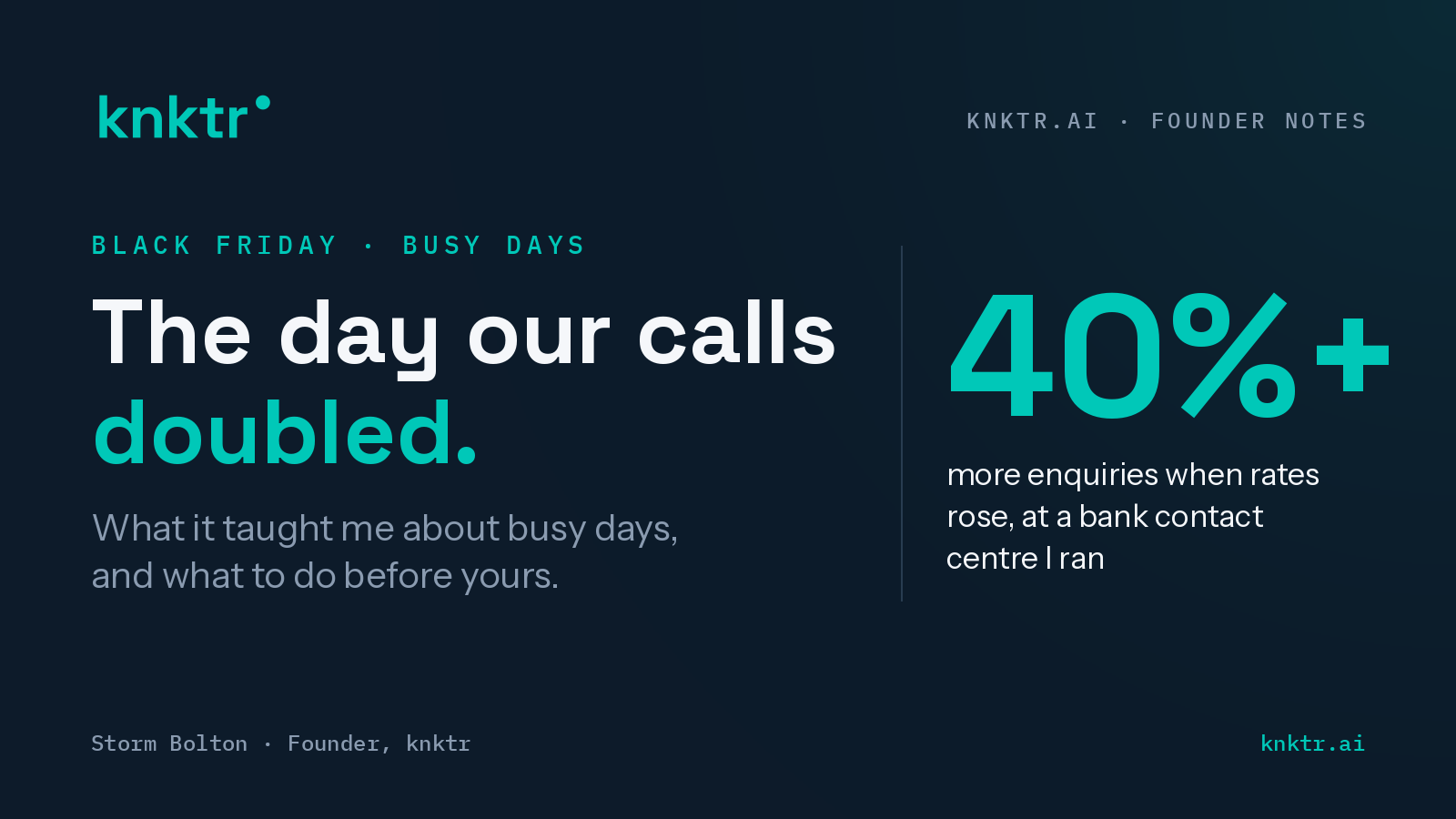
I remember the day the phones went nuts. I was managing a contact centre, and one of our clients was running a big sale.
They'd done the modelling, and we'd staffed to their numbers. What they didn't tell us was that they'd upped their marketing spend. Calls roughly doubled. Then the calls got longer, because every extra order brought questions with it. Double the calls at longer call times is a lot more than double the work.
The first thing you do is ring around and get more staff in. That takes time. They have to travel in, log in and get up to speed, and in the meantime you're missing calls. We missed our service levels, which strained the relationship and cost us money under the contract. But the bigger cost was the sales the client lost. When a customer can't get through, they don't wait.
What stayed with me from that day was speed to move. The old way, calling people in, pulling staff off other work and trying to get them up to speed, can't turn on a backup plan fast enough. Those customers and those sales are gone, and you never get that back.
Every business has its Black Friday
Black Friday is 27 November this year, and the Australian Retail Council and Roy Morgan are tipping a record $7.2 billion in spending over the four days. But it's not just retail that has days when the phones run hotter than the team can handle.
For a lender or broker, it's the week rates move. When I ran the outsourced contact centre for a large Australian bank, a rate rise pushed enquiries up by more than 40%. Brokers see it too: Lendi Group found refinance enquiries on RBA rate-rise Tuesdays ran 157% above other Tuesdays (2022). For a health practice, it's Monday morning, when HotDoc's booking data shows 15 to 25% more bookings than midweek (2019). And for plenty of businesses, it's every night after 5pm: more than half of Australians do their life admin outside 9 to 5 (Qualtrics, 2024).
People don't wait long, either. In a Resonate CX survey of Australians in September 2025, two in three expected a reply within an hour.
What most businesses do, and why it backfires
On a busy day, most businesses pull people from other jobs and put them on the phones. I understand why. But it's like throwing someone in the deep end who's never swum and hoping they don't sink.
The caller has a bad experience, and so does your team member. The question usually gets passed on anyway, so the customer explains it twice and you handle it twice. Nobody wins.
What I'd do before your next busy day
Write down the five questions you get every day, and the answer to each in plain words. Put them on your website and in your emails.
Decide who takes the call nobody can pick up, and how fast you'll call back.
Plan for the week after the peak, not just the day. The follow-up questions keep coming.
Once it's over, look at why people rang. That's your list of things to fix.
Where knktr fits
I've spent about 20 years in contact centres. In the last few years I worked with businesses of all sizes on their own contact centres and on outsourced teams, onshore and offshore, and nothing on offer was affordable or quick to set up. It meant hundreds of thousands of dollars for an implementation plan, then licence fees per head, then extra costs for every added feature. It was very hard to forecast, with not much in it for their customers. I started knktr to remove that barrier.
Our AI answers every call first, day or night, using your own information. When a caller needs a person, a trained one steps in, already briefed on what the caller's after.
Our promise is simple: your customers won't have to repeat themselves. It's the promise I couldn't make on that day in the contact centre.
You also see every conversation: transcripts, summaries and how your callers felt. So your next busy day isn't a surprise.
One thing it doesn't do yet: it only speaks English for now. Other languages are on the roadmap.
Callers are told they're speaking with AI. Call data is stored and processed in Australia, personal details and card numbers are redacted from transcripts, and it's never used to train AI models. You pay for what you use: no seats, no shifts, no minimums. Most clients start with after-hours cover and grow from there.
If you know your busy day is coming, book a demo and bring your hardest customer question.
This post is general information.
References
Australian Retail Council and Roy Morgan, record $7.2 billion Black Friday weekend tipped, 11 November 2026. Survey of 7,654 Australians.
Lendi Group (including Aussie) data, 1 May to 30 September 2022, reported in The Adviser, "Rate shock spikes borrower concerns", 14 October 2022.
HotDoc, online booking data, published 23 August 2019.
Qualtrics study reported in IT Brief, "Australian brands risk $74bn over poor out-of-hours service", 20 March 2024.
Resonate CX, State of customer service expectations 2025: Australia, September 2025.