
The calls you miss after hours: what the numbers actually say
Most missed-call statistics are recycled folklore. The few that hold up say 82% of callers would try a competitor. Here's what's real, and how to measure your own.
Search "missed call statistics" and you'll find hundreds of confident numbers. Most of them can't be traced to any study. The few that can still tell you plenty about what happens when your phone rings after 5pm and nobody picks up.
This post separates the two, then shows you how to get the only number that really matters: your own.
The numbers you should stop quoting
These turn up on almost every vendor blog. None of them leads back to a study you can check.
"80–85% of callers won't leave a voicemail." It traces to an unattributed 2014 magazine piece.
"85% of people whose call goes unanswered won't call back." It traces to a vendor blog with no source.
"Missed calls cost a small business $126,000 a year." It's one vendor's arithmetic, not a measurement.
They may be roughly right. But if a number can't be checked, it shouldn't be driving a decision about your business.
What callers actually do when nobody answers
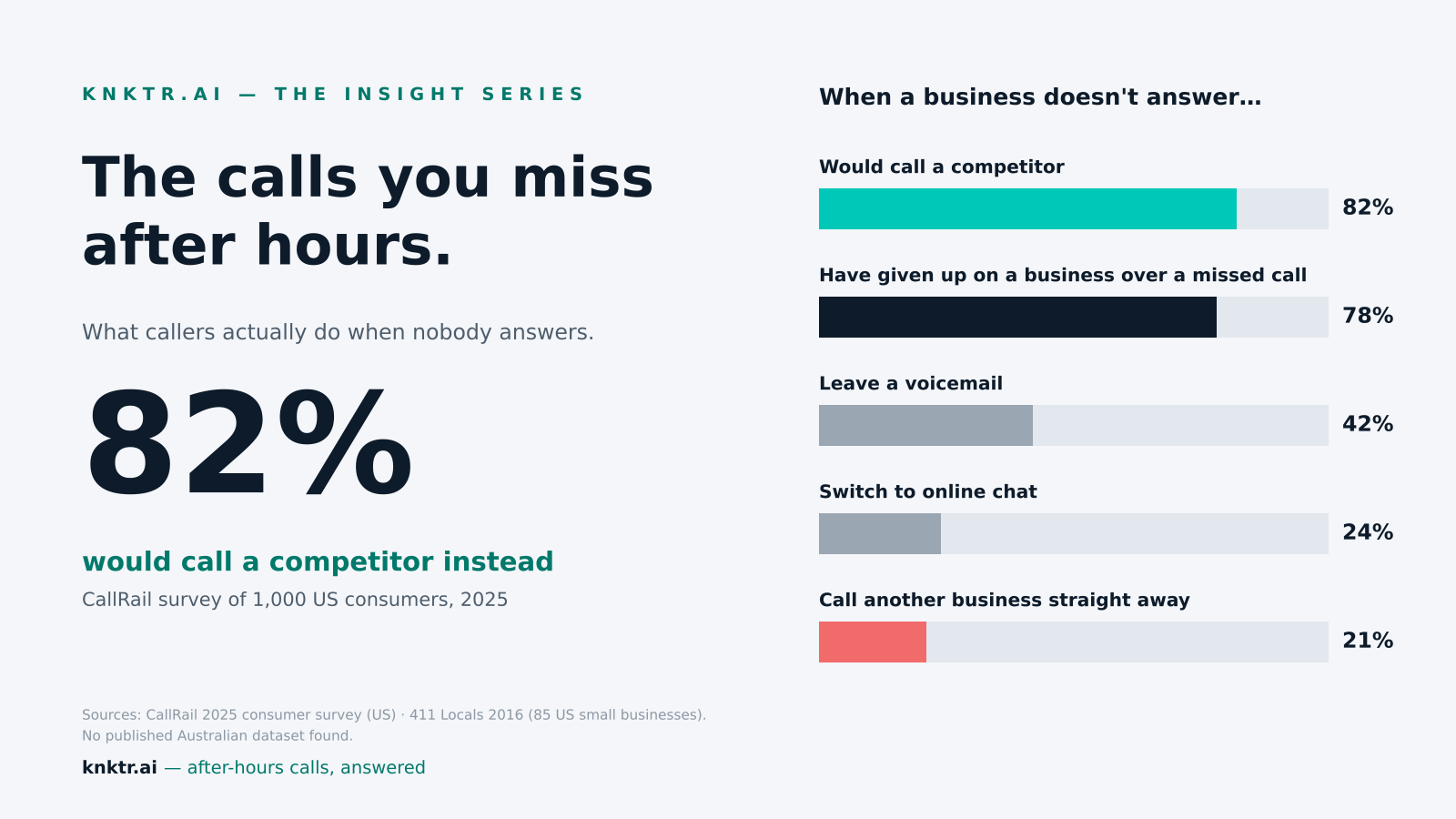
The best recent data is a 2025 survey of 1,000 US consumers by CallRail, a call-tracking company. When a business doesn't answer:
82% say they'd call a competitor, and 21% would do it straight away.
78% say they've already given up on a business over an unanswered call.
Only 42% leave a voicemail. The rest hang up, or try another channel: 24% switch to online chat.
The same survey found 52% think a business using AI to answer after hours gives better service, not worse.
The longest-running measurement of small businesses is older and smaller. A 2016 study of 85 US small businesses over 30 days found only 37.8% of calls were answered. Another 37.8% went to voicemail, and 24.3% got no response at all.
Both are American. We couldn't find a published Australian study of either. There's no obvious reason Australian callers are more patient, but treat the numbers as a guide, not a forecast.
How many of your calls come after hours
Nobody publishes a reliable answer, and the figures that do exist come from companies that sell after-hours answering.
One US answering service reported in September 2026 that 47% of the call time it handled fell outside weekday working hours. Its clients are businesses that already pay for after-hours cover, so expect that to run high.
Another vendor's own lines showed 30.1% of conversations outside 8am–6pm on weekdays, across nine businesses.
So somewhere between a quarter and a half of calls is a fair working range for a business that serves the public. A business-to-business firm will usually sit lower; trades, health and anything urgent will sit higher.
The point isn't the exact figure. It's that a meaningful share of your callers ring when nobody is there, and most of them won't leave a message.
What "after hours" usually means for a small business
For most small businesses, a call after 5pm ends one of four ways:
Voicemail. Fewer than half of callers leave a message, and the ones who do expect a call back first thing.
Diverted to someone's mobile. It works until that person is at dinner, asleep or on leave, and it wears them out.
An answering service. A person takes a message. The caller is heard, but nothing is resolved until your team calls back.
Nothing. The phone rings out.
None of these answers the question the caller rang with. Most after-hours calls are simple: opening hours, prices, a booking, where an order is up to. Those are exactly the calls that are easy to answer and expensive to lose.
What a good after-hours answer looks like
Whoever or whatever answers your phone at 9pm, hold it to this:
It answers the common questions properly, from your own information, not a script that reads out your website.
It knows when to stop. If it can't resolve the call, it takes the caller's details and the reason properly, rather than guessing.
It tells the caller what happens next, including when they'll hear back.
It hands your team a clean list in the morning: who called, what they wanted, and what's still open.
It's upfront. Callers are told they're talking to AI and that the call is recorded.
It keeps the data where you'd expect. Recordings and transcripts stay in Australia, and they aren't used to train anyone's AI.
Measure it this week
You don't need anyone's statistics. You need a week of your own.
Pull the missed-call log from your phone system or provider for the last seven days.
Split it by hour, and count how many came outside the hours someone was answering.
Call ten of those numbers back and ask what they needed. You'll learn more from those ten conversations than from any survey.
If the after-hours share is small, voicemail is fine. If it's a quarter or more, that's revenue ringing out every night.
Figures in this post are from US studies and vendor data, as noted. We found no published Australian dataset on missed or after-hours calls.
Where knktr sits
After hours is the easiest place to start with us. Our AI voice agent answers every call that comes in when your team has gone home, using your own knowledge: hours, services, bookings, the questions you hear every day.
When it can't resolve a call, it doesn't guess. It takes the caller's details and the reason, tells them when they'll hear back, and has it waiting for your team first thing.
You keep your own people on the phones during the day and see what the AI handles at night before you trust it with anything more.
Callers are told they're speaking with AI. Call data is stored and processed in Australia and never used to train AI models, and personal details, including card numbers, are redacted from transcripts. You can be live in days, not months.
We're onboarding a small group of founding design partners now. If your phone rings after hours, book a demo and we'll show you how it would answer your callers.
knktr.ai — Australia's AI-first hybrid contact centre. Stored and processed in Australia.
References
CallRail, Missed calls cost businesses more than ever, 25 September 2025. Survey of 1,000 US consumers.
411 Locals, Small business owners don't answer 62% of phone calls, January 2016. 85 US small businesses over 30 days.
AnswerConnect, Data reveals 47% of business calls occur after hours, 23 September 2026. US call minutes, April to June 2026; vendor data.
OnCrew, Missed call statistics: verified numbers, real sources. Traces common figures to their origins; its own lines showed 30.1% of conversations after hours across nine businesses; vendor data.
This post is general information. US survey and vendor figures are labelled as such.