
In-house, outsourced or AI-first: what answering your phones costs at 10, 30 and 100 calls a day
At 10 calls a day, a dedicated hire costs about A$47 a call in wages alone. At 100, about A$10. The difference is the hours the phone doesn't ring.
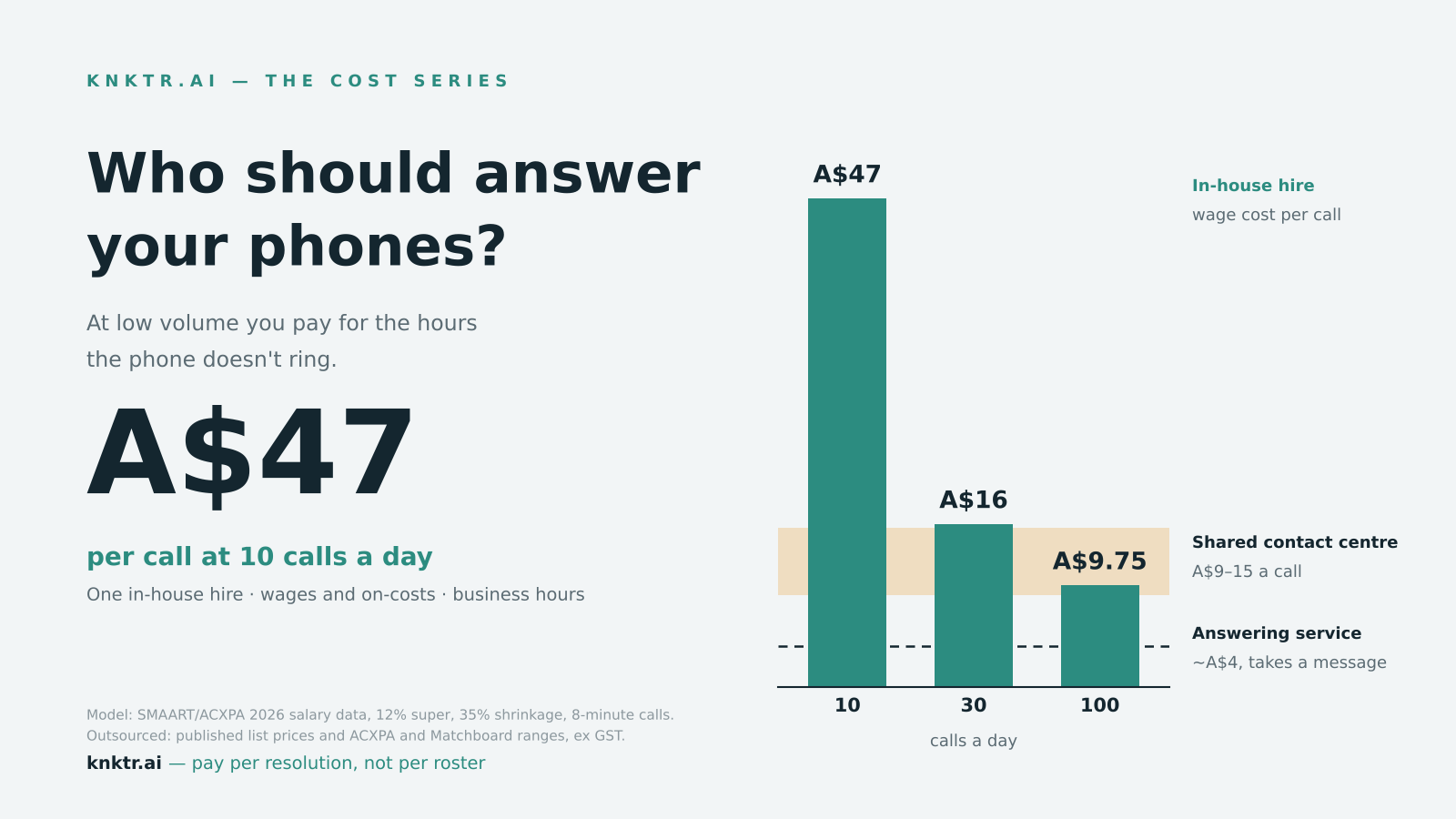
The cheapest way to answer your phones depends on how many calls you get. At 10 calls a day, a dedicated hire costs about A$47 a call in wages alone. At 100 calls a day, the same maths gives about A$10. The difference isn't the person. It's the hours the phone doesn't ring.
This post runs three options against three volumes, with the working shown, so you can put in your own numbers.
The three options
In-house. You hire, train and roster your own people. You pay for every hour they're rostered, busy or not.
Outsourced. Someone else's people answer for you. This ranges from an answering service that takes a message to a contact centre that handles the whole call.
AI-first, with people behind it. An AI voice agent answers every call and resolves what it can from your own knowledge. When a call needs a person, it hands over to a trained agent with the full history.
The number that decides it: idle time
An in-house team is a fixed cost. You pay for the seat whether one call comes in or twenty.
Keeping one phone answered every business hour takes about 1.5 full-time people, not one. People take leave, get sick, train and take breaks, and the industry allows 30–35% for it.
At the national average of A$64,393 a year, plus 12% super and other on-costs, that's about A$117,000 a year. That's before a desk, a phone system or anyone to manage them.
At 10 calls a day
Ten calls of eight minutes is 80 minutes of work in an eight-hour day. A hire answers them and waits the rest of the day. That's about A$47 a call in wages.
An answering service is far cheaper: about A$4 a call with one national provider. But it takes a message. Someone in your business still calls back, so the call is answered twice and resolved once, by you.
A shared contact centre billing by the minute, at published rates for markets like ours, lands at about A$9–15 for an eight-minute call. It can resolve simple questions if you script and train it, but many set minimum spends or terms.
At this volume the real choice is between a message and an answer. Paying a person to wait is the expensive option.
At 30 calls a day
Four hours of calls in an eight-hour day. One person is now busy about half the time, and the wage cost falls to about A$16 a call.
The catch is the peaks. Calls don't arrive evenly, so two will often ring at once. With one person, the second caller waits or goes to voicemail. Covering that properly means a second person for the busy hours, and the cost per call climbs back up.
Outsourced and AI-first options carry the peaks for you. That's most of their value at this volume.
At 100 calls a day
Now you're running a small contact centre. About 3.2 full-time agents cover the work, and wages come to about A$9.75 a call. Add a team leader, quality checks, staff turnover, systems and space, and our earlier post put the full figure at about A$14.75 a call.
A dedicated onshore team from an outsourcer, at A$45–60 an hour for entry-level work, lands around A$7.50–10 a call. That's before management fees and minimum hours. Offshore is cheaper by the hour, but your callers' recordings and details then leave Australia.
At this volume in-house can work, if you're ready to recruit, train, roster and replace people. Many founders aren't, and shouldn't be at this stage.
What the numbers leave out
After hours. Every figure above is business hours only. Covering evenings and weekends in-house adds penalty rates and roster gaps.
Resolution. A message isn't an answer. Count how many "answered" calls still need a call back.
Where the data goes. Recordings and transcripts sit wherever your provider keeps them. Ask before you sign.
Your own time. Rostering, training and covering sick days lands on someone, usually the founder.
How to choose
Count your calls and their length for one ordinary week. Most businesses guess too high or too low.
Work out what share could be answered from what you already know: hours, prices, policies, bookings, order status.
Decide what a caller should get: a message, an answer or a person. Then price that, not the cheapest line on a list.
The working: 8-minute calls, 80% occupancy, 35% shrinkage, 250 working days, A$64,393 salary plus 18% on-costs (12% super, leave loading, workers' compensation), and at least one person on the phone every business hour. Outsourced figures are published list prices and industry ranges, ex GST. Your numbers will differ.
Where knktr sits
knktr is the third option. An AI voice agent answers every call from your own knowledge base and resolves what it can. When a call needs a person, a trained human agent picks it up with the full history, so your customer doesn't repeat themselves.
You pay per resolution, not per seat or per rostered hour. A busy Monday doesn't mean a second hire.
Call data is stored and processed in Australia and never used to train AI models. Personal details, including card numbers, are redacted from transcripts. You can be live in days, not months.
We're onboarding a small group of founding design partners now. If you take customer calls and want to see the numbers for your own volume, book a demo.
knktr.ai — Australia's AI-first hybrid contact centre. Stored and processed in Australia. Pay per resolution.
References
ACXPA, Australian contact centre salaries, SMAART Recruitment 2026 data. A$64,393 national average, customer service agent, plus super.
Australian Taxation Office, The final SG rate increase is coming on 1 July. Super guarantee 12% from 1 July 2025.
Virtual Headquarters, Pay per call answering service. From A$33 a month plus A$3.89 a call for live answering, ex GST.
Matchboard, Call centre outsourcing pricing in Australia, updated April 2026. Shared-agent inbound in developed markets around A$1.10–1.90 a minute (citing Twilio).
ACXPA, Outsourcing to an Australian contact centre: worth it?, updated July 2026. Onshore entry-level A$45–60 an hour, ex GST.
knktr, What a phone call really costs your business. Built-up cost of about A$14.75 a call at 100 calls a day.
This post is general information. Prices are published list prices and industry ranges at the time of writing, ex GST.