
Nine questions to ask before an AI vendor touches your customer calls
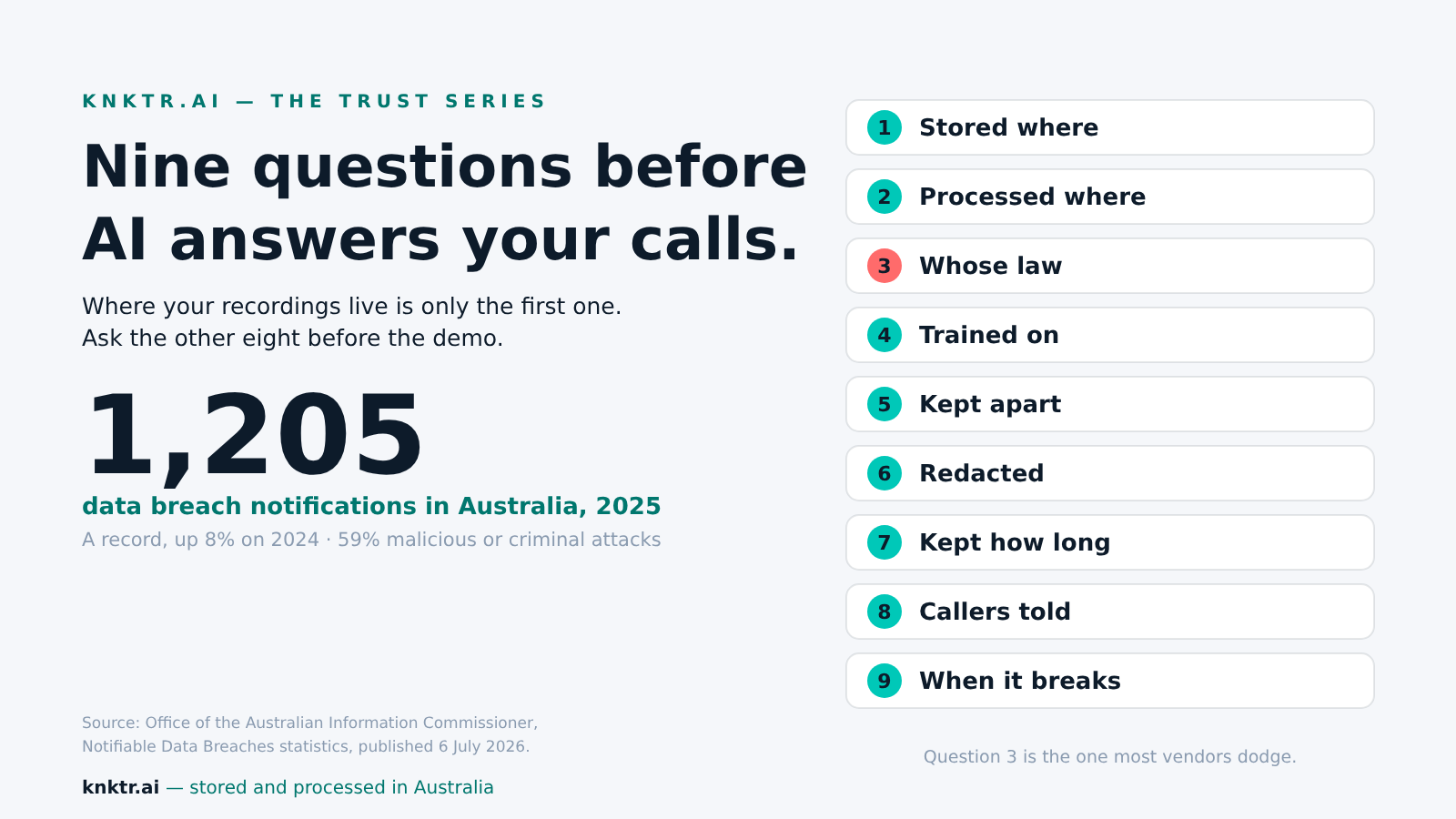
Australian data breach notifications hit a record 1,205 in 2025. Before an AI answers your phones, ask where the recordings go, who can reach them, and what happens when you leave.
A phone call is the most personal data your business collects. In four minutes a customer will give you their name, their address, their date of birth, the reason they're upset and, often enough, something about their health or their money. Then it becomes a recording, a transcript and a summary, and it sits somewhere for a year.
If you're a founder, an owner or a head of support thinking about putting AI on your phones, the question most vendors want you to ask is "how good is the AI?". This post is about the question that comes before it: what happens to the call afterwards. Here are nine things to ask, why each one matters, and the answers that should make you slow down.
This is a buyer's checklist, not legal advice.
Why it matters more this year
Australian organisations reported 1,205 data breaches to the privacy regulator in 2025, the highest number since reporting began and 8% up on the year before. Six in ten were malicious or criminal attacks. Health was the most affected sector, with financial services second (OAIC).
You might be small enough to sit outside the Privacy Act; businesses turning over $3 million or less generally do. But health service providers are covered at any size, and the larger customers you want to win will hold you to the standard regardless. Their security questionnaire doesn't have a small-business exemption.
The nine questions
1. Where are my recordings and transcripts stored? Ask for the country and the city, in writing. "In the cloud" is not an answer, and "in Australia by default" often means "unless you're on the cheaper plan".
2. Where is the data processed, including by the AI model? This is the one people miss. A vendor can store your recordings in Sydney and still send every transcript overseas for the AI to read, summarise or score. Storage and processing are two separate questions. Ask about the model, the transcription, the summaries and the search index, one by one.
3. Who is the infrastructure provider, and whose law can reach them? Where the data sits and who can be compelled to hand it over are different things. Under the US CLOUD Act, American authorities can require a US-based provider to produce data it controls, wherever that data is stored. Australia and the US have had an agreement in force since January 2024 covering serious crime. Almost every vendor runs on a US-headquartered cloud, so the honest answer is rarely "nobody can". What you're listening for is whether the vendor has thought about it. "We're immune" is a warning sign.
4. Is my customers' data used to train AI models, yours or anyone else's? You want a flat no, covering the vendor and the model provider behind them, written into the agreement. "Only to improve our service" is a yes.
5. How is my data kept apart from your other clients'? Ask how the separation is enforced and how it was tested. A good answer describes a real test: one client's login tried against another client's data and refused. Ask about the people too: who can see your customers' data, and how is that access approved?
6. What gets redacted, and when? Card numbers, dates of birth and addresses turn up in transcripts whether you want them or not. Ask what is removed automatically, and whether that happens before the transcript is stored or after.
7. How long do you keep it, and what happens when I leave? Three parts: the standard retention period, how you get your data out, and what proof you get that it has been deleted. If you're in financial services, the NDIS or aged care, check the period against your own record-keeping obligations, which may run to years.
8. How do callers know they're being recorded, and that they're talking to AI? Recording laws differ between states and territories, and several require everyone on the call to consent, so the announcement at the start of the call matters. The regulator's guidance on AI products also says public-facing tools like chatbots should be clearly identified as AI. And from 10 December 2026, organisations covered by the Privacy Act must explain in their privacy policy where a computer program uses personal information to make, or substantially help make, decisions that significantly affect people. If an AI on your phone line can approve, refuse or cut something off, that may be you.
9. What happens when something goes wrong? It's your customer's data, so you may be the one who has to tell them and the regulator. Ask how quickly the vendor will tell you, what they'll hand over, and who their own suppliers are. The regulator has repeatedly pointed to third-party providers as a source of breaches. Under Australian privacy law, if personal information goes to an overseas recipient, you generally stay accountable for what they do with it.
How to use the answers
Send the nine questions by email before the demo and ask for written replies. Vendors who have done the work answer in a day, with specifics. Vendors who haven't will book a call instead.
You're not looking for a perfect score. Nobody has one. You're looking for specific answers, limits stated plainly, and a vendor who doesn't flinch at question three.
Where knktr sits
It would be poor form to hand you nine questions and not answer them ourselves. Here is where we stand today, including the parts that aren't tidy.
Stored where. In Australia.
Processed where. In Australia. That includes the AI model, the transcription and the summaries. We audited this ourselves rather than taking a supplier's word for it.
Whose law. We don't claim immunity from anyone's law, and we'll walk you through exactly who our providers are in the first meeting.
Trained on. No. Your calls are never used to train models, ours or anyone else's.
Kept apart. Every request is checked against the client it belongs to, and we tested it by trying one client's login against another's data. It was refused. Our people only get access to the clients they've been approved for.
Redacted. Personal information is redacted automatically from the transcripts you receive, card numbers included.
Kept how long. Twelve months as standard, with longer retention available for regulated teams. You can export your data at any time.
Callers told. Every call opens with a recording notice, built to the strictest state standard and used nationally.
When it breaks. We're early, so we won't quote you a track record. We'll walk you through our data register and our supplier list before you sign anything.
We're onboarding founding design partners now. If you're a founder or head of support in fintech, healthtech, insurance, the NDIS or aged care and you'd like to put these nine questions to us directly, book a demo and bring your security questionnaire. We'd rather answer it in the first meeting than the fifth.
knktr.ai — Australia's AI-first hybrid contact centre. Stored and processed in Australia. Outcome-priced.
References
Office of the Australian Information Commissioner, Data breach notifications increase to all-time high in 2025, 6 July 2026. 1,205 notifications in 2025, up 8% from 1,112; 59% malicious or criminal; health the top sector.
OAIC, Latest Notifiable Data Breach statistics for January to June 2025, 4 November 2025. Risks from third-party service providers.
OAIC, Guidance on privacy and the use of commercially available AI products, 21 October 2024. Due diligence, and identifying public-facing AI tools as AI.
OAIC, Australian Privacy Principles Guidelines, Chapter 8: cross-border disclosure of personal information, updated October 2025. Accountability for overseas recipients.
Department of Home Affairs, Australia–United States CLOUD Act Agreement. Signed December 2021, in force January 2024; offences carrying three years or more.
Gilbert + Tobin, Automated decision-making transparency under the Privacy Act, 19 August 2026. The 10 December 2026 privacy policy requirement.
OAIC, Small business. The $3 million small-business exemption and who it doesn't cover.
This post is general information, not legal advice. Figures are the most recent published at the time of writing.