
Getting your business ready for an AI agent: what to hand over before it answers a single call
An AI agent is only as good as what you give it. Here's what to hand over, what to keep for your team, and a five-day checklist to get ready.
An AI agent answers your phones with whatever you give it. Give it a tidy, current picture of your business and it sounds like your best staff member. Give it an old price list and three versions of your refund policy, and it will confidently tell callers the wrong thing.
This post covers what to hand over, what to keep for your team, and how to get ready in a week.
Why AI agents give wrong answers
Usually it isn't the AI. It's what the AI was given.
In 2024 a Canadian tribunal ordered Air Canada to pay a passenger C$812 after its website chatbot told him he could claim a bereavement discount after flying. The airline's actual policy said he couldn't. Air Canada argued it wasn't responsible for what the chatbot said. The tribunal disagreed: a business is responsible for all the information on its website, whether it comes from a page or a chatbot.
The same problem shows up at scale:
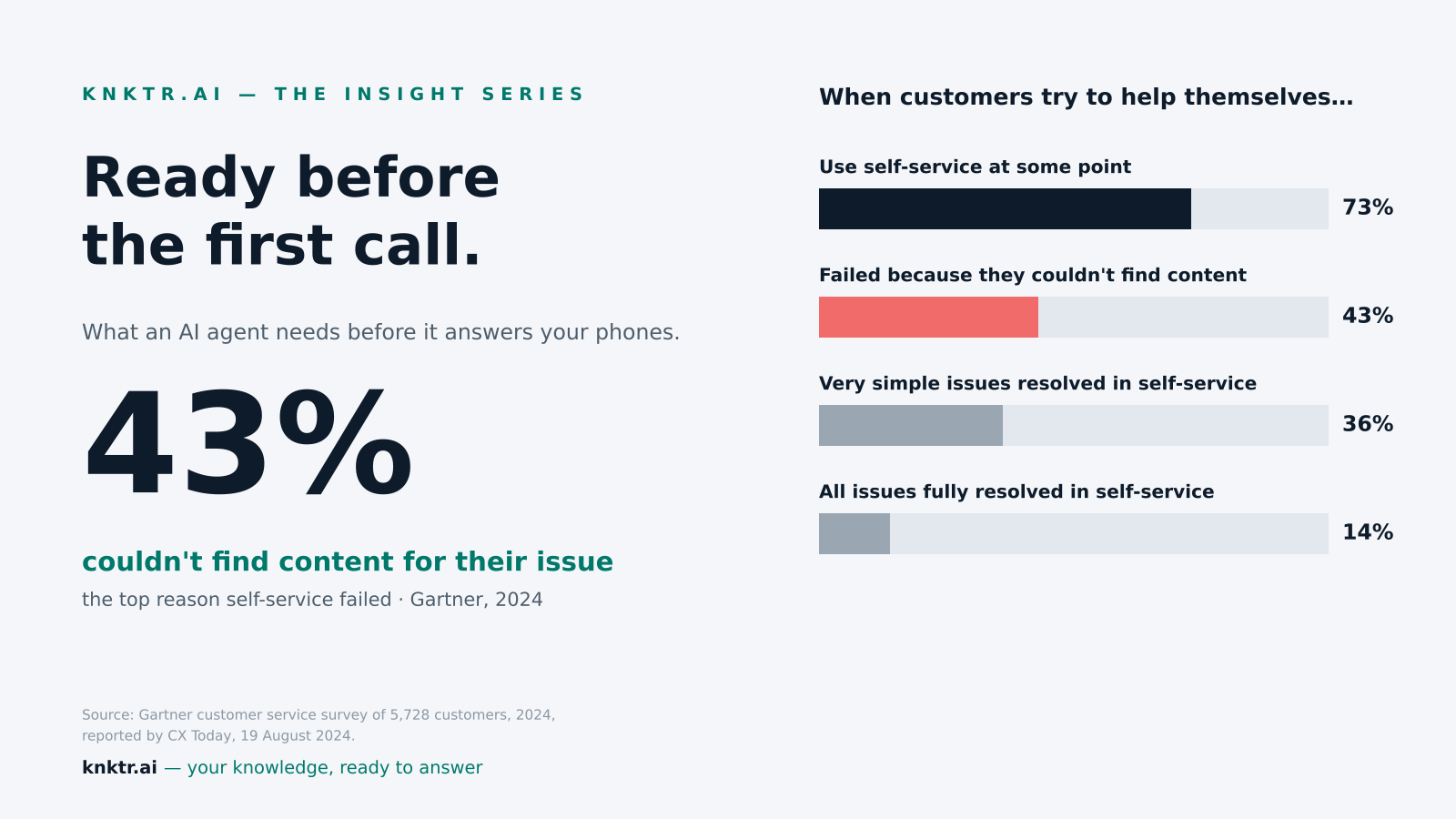
In a 2024 Gartner survey of 5,728 customers, only 14% of service issues were fully resolved through self-service. The most common reason it failed: 43% couldn't find content relevant to their issue.
In a 2025 survey of 316 people working on AI and knowledge, released by a knowledge-software vendor, 61% named wrong or inconsistent answers as their top concern about using AI more widely.
Callers don't care why the answer was wrong. They remember that it was.
What to hand over
Start with what callers actually ask, not with what's on your website.
Your most common questions. Pull a month of call notes, emails or enquiries and list the top 20. These are what the AI must get right first.
The answers, in your words. Hours, locations, services, what's included and what isn't. Short and specific beats long and polished.
Prices, or a rule about prices. Either give the AI your current prices, or tell it exactly what to say instead, such as "it depends on your situation, a team member will quote you". Don't leave it to guess.
Your policies, with the exceptions. Refunds, cancellations, bookings, warranties. The exceptions matter most: the Air Canada answer went wrong on one.
What it must never say or promise. Discounts, legal or medical advice, delivery dates you can't guarantee.
When to hand to a person, and who. Complaints, hardship, anything over a certain value, anyone who asks.
What's changing soon. Price changes, holiday closures, a new service. Give the date it takes effect.
Two kinds of knowledge
Not everything you know should be said to a caller.
What callers can hear: hours, services, policies, how to book.
What only your team should see: who can approve a refund above a certain amount, internal escalation contacts, notes on difficult accounts.
Keep them apart from day one. An AI that reads your internal notes to a customer is a worse problem than one that doesn't know the answer.
Clean it up before it goes in
Most businesses find the same three problems when they gather their documents:
Contradictions. The website says 30 days, the terms say 14, the FAQ says "contact us". Pick one.
Old versions. Last year's price list sitting next to this year's. Delete the old one; don't just add the new one.
No owner. Nobody is responsible for keeping it current. Name one person.
A five-day checklist
Monday: pull your top 20 questions from a month of calls, emails or enquiries.
Tuesday: write or collect the answer to each, in plain words.
Wednesday: gather your policies and price rules, and mark what callers may hear and what only your team should see.
Thursday: remove contradictions and old versions. Name the person who owns updates.
Friday: write down what the AI must never say, and when it should hand over to a person.
Test it before it answers a real caller
Before you go live, ring it yourself.
Ask your top 20 questions and check every answer.
Ask five awkward ones: an angry complaint, a question you don't cover, a request for a discount.
Ask for a person and check the hand-over works, and that your team sees what was already said.
Then keep it current. The day a price or policy changes, the AI's knowledge changes too.
Figures are from Gartner and a vendor-released industry survey, as noted. The Air Canada case is Canadian. This post is general information.
Where knktr sits
Getting ready is part of how we onboard. You upload your documents through a secure link. We check them for contradictions and ask you to settle each one before anything goes live, so the AI never has two answers to the same question.
We keep what callers can hear separate from what only your team sees, and your knowledge separate from every other client's. Then we test with real calls before your first caller hears it.
Callers are told they're speaking with AI. Call data is stored and processed in Australia and never used to train AI models, and personal details, including card numbers, are redacted from transcripts. You can be live in days, not months.
We're onboarding a small group of founding design partners now. Book a demo and bring your top 20 questions. We'll show you how it would answer them.
knktr.ai — Australia's AI-first hybrid contact centre. Stored and processed in Australia.
References
AI Business, Air Canada held responsible for chatbot's hallucinations, February 2024. Moffatt v. Air Canada, Civil Resolution Tribunal (British Columbia), 14 February 2024.
CX Today, Only 1 in 7 customer service queries resolved with self-service, Gartner study finds, 19 August 2024. Gartner survey of 5,728 customers.
eGain / GlobeNewswire via Stock Titan, Why AI projects fail: survey, 3 June 2025. Enterprise AI/KMWorld survey of 316 respondents; released by a knowledge-software vendor.
This post is general information. Survey figures are labelled with their source.