
Most callers can't tell it's AI. We tell them anyway.
Most callers can't tell whether they're talking to AI. The trouble starts with the odd request, and that's why we tell them up front.
Most callers can't tell whether they're talking to an AI, or to an outsourced contact centre. The scripts are that good, and the answers to common questions are usually spot on.
It's the odd request that gives it away. A customer rings about a payment that's been flagged. They could be talking to an AI agent: the pace is right, it's matching and mirroring them, the conversation flows. Then they say, "Do you mind holding off that payment until next Friday, when my partner's back? He's travelling."
That's where a heavily scripted agent, AI or human, gets rigid, and the wheels come off. If that caller thought they were talking to a person, they now feel tricked as well as stuck.
Why businesses want to hide it
I hear three fears.
Hang-ups. The caller hears "AI" and either hangs up or demands a person straight away.
Looking cheap. Small and mid-sized businesses worry an AI makes it look like they can't afford real staff. Perception matters.
Lost sales. On sales and retention lines, they worry buyers will shut down the second they know it's software.
Where they're right
AI is not a great closer once it's disclosed. In a 2019 field experiment, more than 6,200 customers got outbound sales calls from a bot or a person. When the bot said it was a bot before the conversation, purchases fell by more than 79.7% (Luo and others, Marketing Science). For hard selling, or talking someone out of cancelling, a disclosed bot ticks the compliance box but doesn't convert.
And bad bots burn the bridge. Only 27% of customers say they'd try a chatbot again after a bad experience (Gartner, 3,566 customers, 2026). One terrible answer and most won't come back.
Where they're wrong
Speed beats species. Customers care far more about getting it sorted than about who sorts it. 76% don't care who resolves their issue as long as it's done quickly and completely; in Australia and New Zealand it's 62% (Genesys, 5,811 consumers, 2026).
What they won't forgive is a hidden way out. 87% say a company using AI must give them a way to reach a person (Gartner, 2026). And 35% say they often or always have to repeat themselves after being handed from an AI to a person (Five9, 2026). That's the bit that loses customers, not the disclosure.
One more thing I saw in my contact centre years: on a cancellation call, people drop their guard with a bot. They skip the social politeness and just tell you why they're leaving. You can learn more from that call than from one with a person.
What callers say they want
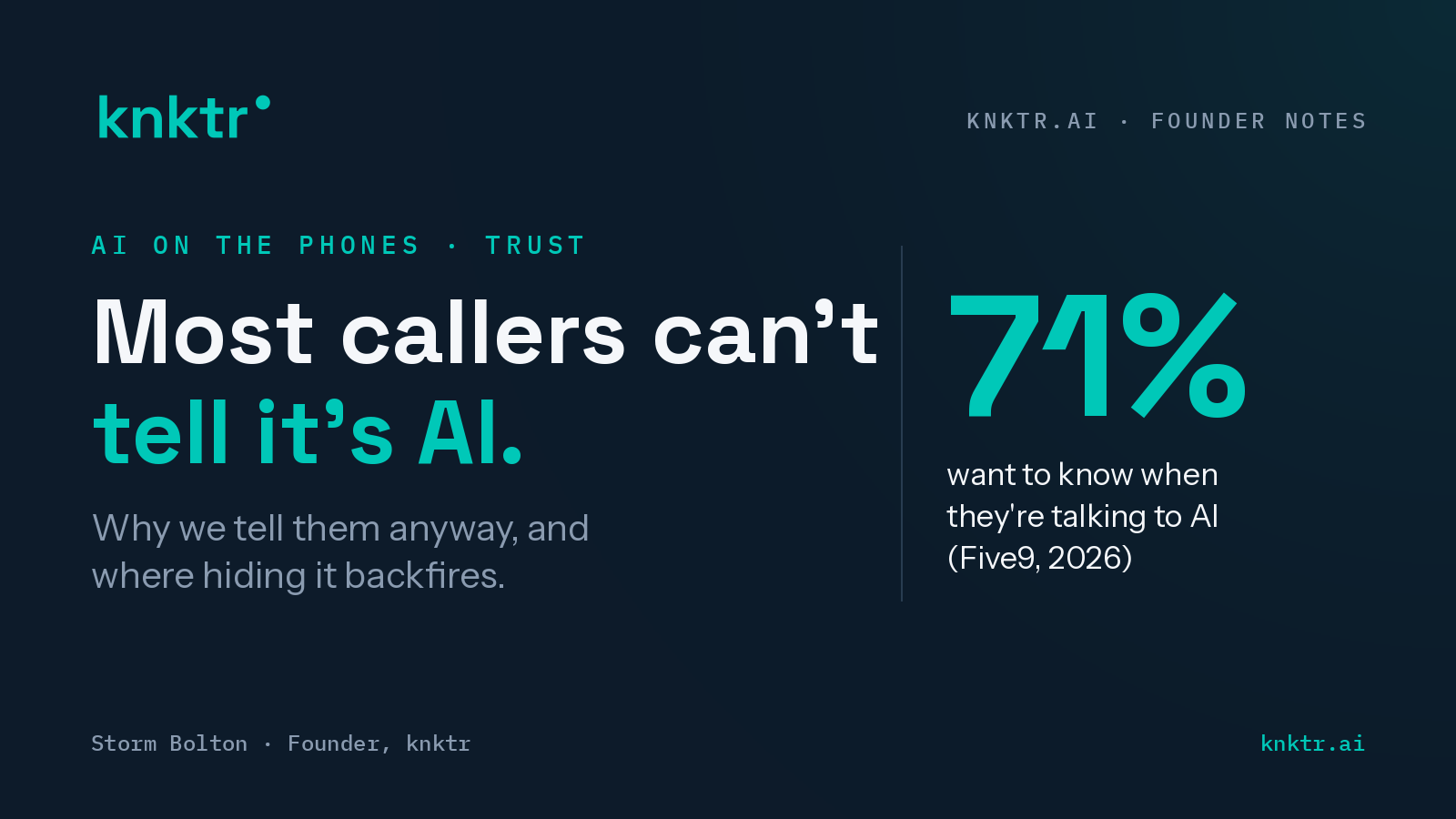
71% say it's very or extremely important to know when they're talking to an AI agent (Five9, 3,000 consumers in the US, UK and Germany, 2026).
40% of shoppers said they'd feel misled if a brand didn't tell them (Talkdesk, US shoppers, January 2026).
42% say a person's mistake is more forgivable than an AI's; only 7% say the reverse (Medallia, March 2026). Hide the AI, and when it slips, you pay the steeper price.
What I'd tell a mate who runs a brokerage
Tell them first. In finance you live and die by compliance, and your clients are handing over payslips, bank details and financial statements. You don't lose clients by saying it's AI. You lose them by making them wait on hold, sending them to voicemail at 6pm, or trapping them in a bot that won't put them through to you.
Why knktr always tells callers
No gotcha moments. Saying it up front sets the expectation from the first second. Callers forgive a quirk when they know it's AI. Pretending to be human turns a small glitch into a betrayal.
Built to the strictest standard. Every call opens with a clear recording and AI notice, built to the strictest state standard and used nationwide.
A person when it matters. The AI handles routine questions from your own information. When a call needs judgment, empathy or complex advice, it goes to a trained person with the full conversation, so the caller won't have to repeat themselves.
Open about the data too. Calls are stored and processed in Australia, never used to train AI models, and card numbers are redacted from transcripts.
If you're weighing it up
Say it in the first sentence, plainly.
Make getting a person easy.
Plan for the odd requests. That's where trust is won or lost.
Brief whoever takes over, so the caller doesn't start again.
If your business takes customer calls and you want to hear how a call sounds, book a time at knktr.ai/demo.
Sources: Five9 2026 Consumer CX Report (April 2026); Talkdesk Post-2025 Holiday Shopping Survey (January 2026); Medallia 2026 State of Customer Experience (March 2026); Luo, Tong, Fang and Qu, "Machines vs. Humans", Marketing Science, 2019; Gartner customer service surveys (August and September 2026); Genesys customer experience research (July 2026).