
What a phone call really costs your business
Most founders quote an agent's salary and stop. The true built-up cost per call for Australian teams runs far higher — and per-resolution pricing changes it.
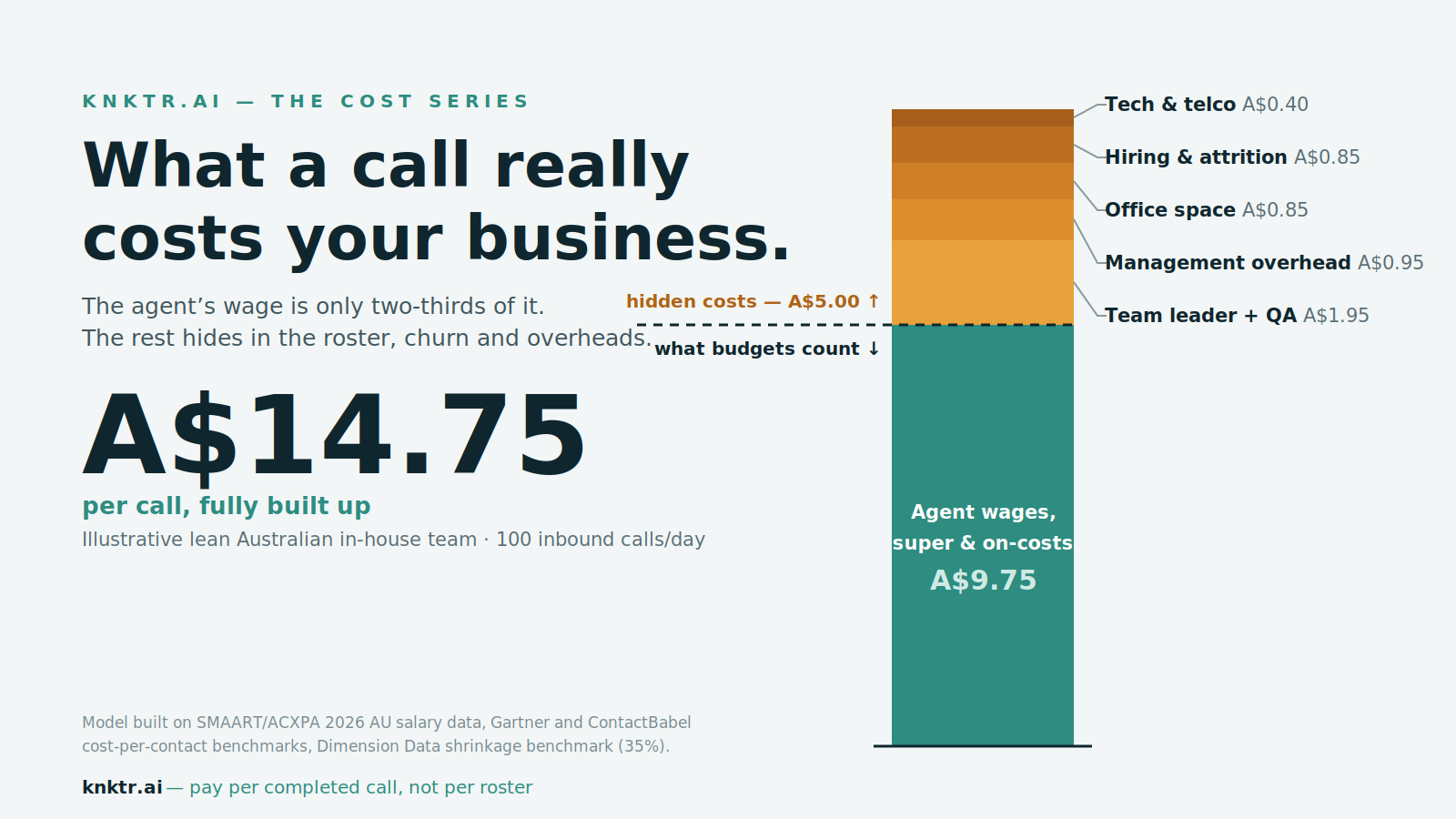
Ask most Australian founders what it costs to answer a customer call and they'll quote you a salary. Divide an agent's pay by the calls they take, done. That number is usually less than half the real figure — and the gap is where support budgets quietly blow out.
If you run a startup, an SME, or a business unit inside something bigger, and your team handles inbound calls — support, bookings, claims, participant enquiries — this post walks through what a call actually costs once you count everything, and why an outcome-priced hybrid AI model changes the maths.
The number everyone quotes vs the number that hits your P&L
Global benchmarks put an assisted contact — a call, chat or email handled by a live person — at a median of US$13.50 per contact (Gartner, 2024). ContactBabel's 2025 US Contact Center Decision-Makers' Guide lands the average inbound call at US$7.16, with complex operations well above that. Gartner's earlier and widely cited figure had live channels averaging US$8.01 per contact against roughly US$0.10 for pure self-service.
Australia sits at the expensive end of those ranges, because our labour costs do. SMAART Recruitment's 2026 national salary data (published via the Australian Customer Experience Professionals Association) puts the average frontline contact centre agent at A$64,393 plus super, with team leaders in the mid-A$90,000s.
So let's build the real number, line by line.
The true built-up cost per call
Here's an illustrative model for a lean Australian in-house team handling 100 inbound calls a day — a typical volume for a Series A–C startup or an SME with a support team of three to five. Assumptions: 8-minute average handle time, 80% occupancy, 32% shrinkage, 250 working days a year (25,000 calls).
1. Agent wages — but more of them than you'd think. 100 calls at 8 minutes each is about 13.3 hours of handling work a day. At a healthy 80% occupancy that's 16.7 on-queue hours. Then shrinkage — leave, sick days, training, meetings, breaks — removes 30–35% of paid time across the industry (Dimension Data's Global Benchmarking Report puts the average at 35%). To keep those calls answered you're rostering about 3.2 full-time agents, not two. At A$64,393 plus 12% super and on-costs (workers comp, leave loading), that's roughly A$243,000 a year — A$9.75 per call.
2. Team leader and QA allocation. Agents don't manage themselves. A team leader (industry-standard ratio around 1:10, mid-A$90,000s in Australia) plus a fractional QA function to score calls adds around A$49,000 a year — A$1.95 per call. And note what you're buying: traditional QA samples 1–3% of calls. The other 97% are never reviewed.
3. Recruitment and contact centre attrition runs 30–45% annually across the industry, and ACXPA estimates replacing one agent costs around 30% of their annual salary — roughly A$19,000–20,000 — in recruitment, induction, training and lost productivity. On a 3-agent team that's about one replacement a year: A$0.85 per call.
4. Technology and contact-centre licences, CRM seats, QA tooling, headsets, plus per-minute call charges: around A$0.40 per call.
5. Office space. A desk, a screen and somewhere quiet to take calls — allocated across the team, about A$0.85 per call (remote teams shift, not remove, this cost).
6. Management overhead. Someone does the rostering, the payroll, the IT tickets, the performance reviews. A conservative allocation adds about A$0.95 per call.
The total: roughly A$14.75 per call. Not the A$6–7 the salary-only maths suggested — and this is a lean, well-run team with no penalty rates, no after-hours coverage, and no growth hiccups. It also lands neatly on top of Gartner's US$13.50 median for assisted contacts, which is reassuring: the build-up isn't pessimism, it's just complete accounting.
And here's the part that stings: that cost is largely fixed. Quiet week? You're still paying for 3.2 agents, the team leader, the licences and the desks. Your cost per call goes up when call volume goes down.
“So we'll outsource it”
A domestic BPO carries every line item above — plus their margin. You're not removing the cost structure, you're renting it with a markup.
Offshore BPO is cheaper per hour, genuinely. But for the sectors we work with — fintech under AFSL and RG 271 obligations, healthtech handling sensitive records, NDIS providers with reportable-incident clocks — the offshore conversation was never really about price. It's about where your customers' voice data lives, who can access it, and what your regulator and your enterprise customers will accept. If your data can't leave Australia, most of that market is off the table regardless of the rate card.
A different way to pay: per completed call
knktr was built on a simple idea: you should pay for resolved calls, not for capacity. Not per seat. Not per hour. Not per agent you had to roster because shrinkage said so.
An AI voice agent — stored and processed in Australia — answers your inbound calls, resolves what it can, and hands the rest to a human agent with live AI assist. You pay one transparent rate per completed call, and it's the same rate whether the AI resolved it or a human did. That's deliberate: we only win when calls get resolved, so our incentives sit on your side of the table.
Rates are set to your call volume — one number per completed call, ex-GST, with a modest monthly commitment of about half your band's capacity. A quiet month costs you half freight, not the full roster you'd be carrying in-house — and exceeding your band never triggers an automatic charge. For most teams around the 100-calls-a-day mark, the per-call rate lands roughly 30% under the built-up in-house figure above, and we'll put the exact number against your own volumes in a 30-minute demo.
What's inside the per-call rate
This is the second half of the cost story — the things the A$14.75 build-up doesn't buy you, included as standard:
Australian data residency by default. Every call is stored and processed in Australia, AI included. No AI training on your data, and every request checked against the client it belongs to.
A transcript of every call, with PII redaction built in. Not a sample — every call, searchable, with 12 months' retention included, and longer retention available for regulated teams.
Sentiment and call insights on 100% of calls. Traditional QA reviews 1–3% of interactions; here every single call is analysed — sentiment, themes, escalation reasons — so you find out what customers are ringing about without commissioning a project.
Human escalation, included. When a call needs a person, a person takes it — with AI assist surfacing answers live. No separate seat licences, no per-hour billing.
Elasticity without rostering. Monday-morning spike, campaign launch, seasonal surge — capacity flexes with volume. No shrinkage, no attrition, no recruitment cycle, no workforce-management spreadsheet.
Live in days. Not a six-month implementation.
The honest comparison
Run your own numbers — the model above is deliberately simple to copy. Take your true fully loaded support cost, divide by calls resolved, and compare. For most Australian teams handling around 100 calls a day, the built-up in-house figure lands between A$12 and A$16 per call before you've paid for a single insight, transcript or compliance control. knktr's per-completed-call rate typically lands around 30% under that — with all of the above included.
One more thing: we're signing five founding design partners. Founding partners get preferential rates, in exchange for a case study and reference rights. Those numbers we share in conversation, not on a webpage — there are five slots, and when they're gone, they're gone.
If you're a founder or head of support in fintech, healthtech, insurance, NDIS or aged care and you want to sanity-check your cost per call — or ask about one of the five slots — we'll happily walk through the model with you against your own numbers.
knktr.ai — Australia's AI-first hybrid contact centre. Stored and processed in Australia. Outcome-priced.
References
Gartner (2024), Benchmarks to Assess Your Customer Service Costs — median cost per assisted contact US$13.50 vs US$1.84 self-service. gartner.com/en/documents/5164231
Gartner (2019), Customer Service and Support Leader poll — live channels US$8.01 per contact vs ~US$0.10 self-service. gartner.com/en/newsroom
ContactBabel (2025), US Contact Center Decision-Makers' Guide — average inbound call cost US$7.16
SMAART Recruitment 2026 Australian Contact Centre Salary Data, via ACXPA — frontline agent national average A$64,393 + super; team leaders mid-A$90,000s; agent replacement cost ~30% of annual salary. acxpa.com.au/australian-call-centre-salaries
Dimension Data, Global Contact Centre Benchmarking Report — average shrinkage 35% (industry norm 30–35%)
Industry attrition benchmarks 30–45% annually (SQM Group, 2025, identifies attrition as the largest driver of falling first-call resolution)
The worked example is an illustrative model using the cited benchmarks and standard industry ratios; your numbers will vary with call volume, handle time and coverage hours.